The challenge
Most small business owners I meet are curious about AI and unsure where to begin. They wear every hat, have little time to experiment, and worry about getting things wrong — sharing private customer data, making promises the business can't keep, or paying for tools they won't use.
The SBDC needed a way to make AI approachable, and to reach owners beyond Bakersfield, including rural communities like Mono County where in-person advisory support is harder to come by.
The approach
I built the curriculum around one principle: AI is only as useful as the context you give it. Instead of a tour of tools, each session teaches owners to brief an AI assistant on their own business and then apply it to the work that costs them the most time.
Teach AI your business
Owners draft a one-page "business context sheet" covering who they are, what they offer, how they operate, how they sound, and what the AI must never do.
Apply it to real tasks
Marketing copy and campaigns, sales data analysis, customer communication, and staff scheduling — each shown with a live example.
Set guardrails
Where to keep humans in the loop: refunds, legal claims, and private customer data stay out of the AI's hands.
Answer live questions
Every session includes open Q&A so owners leave with answers specific to their business.
Give the AI the basics you already know — who you are, what you offer, how you operate, how you sound, and what it must not do.
The core idea behind the "business context sheet" used in the workshop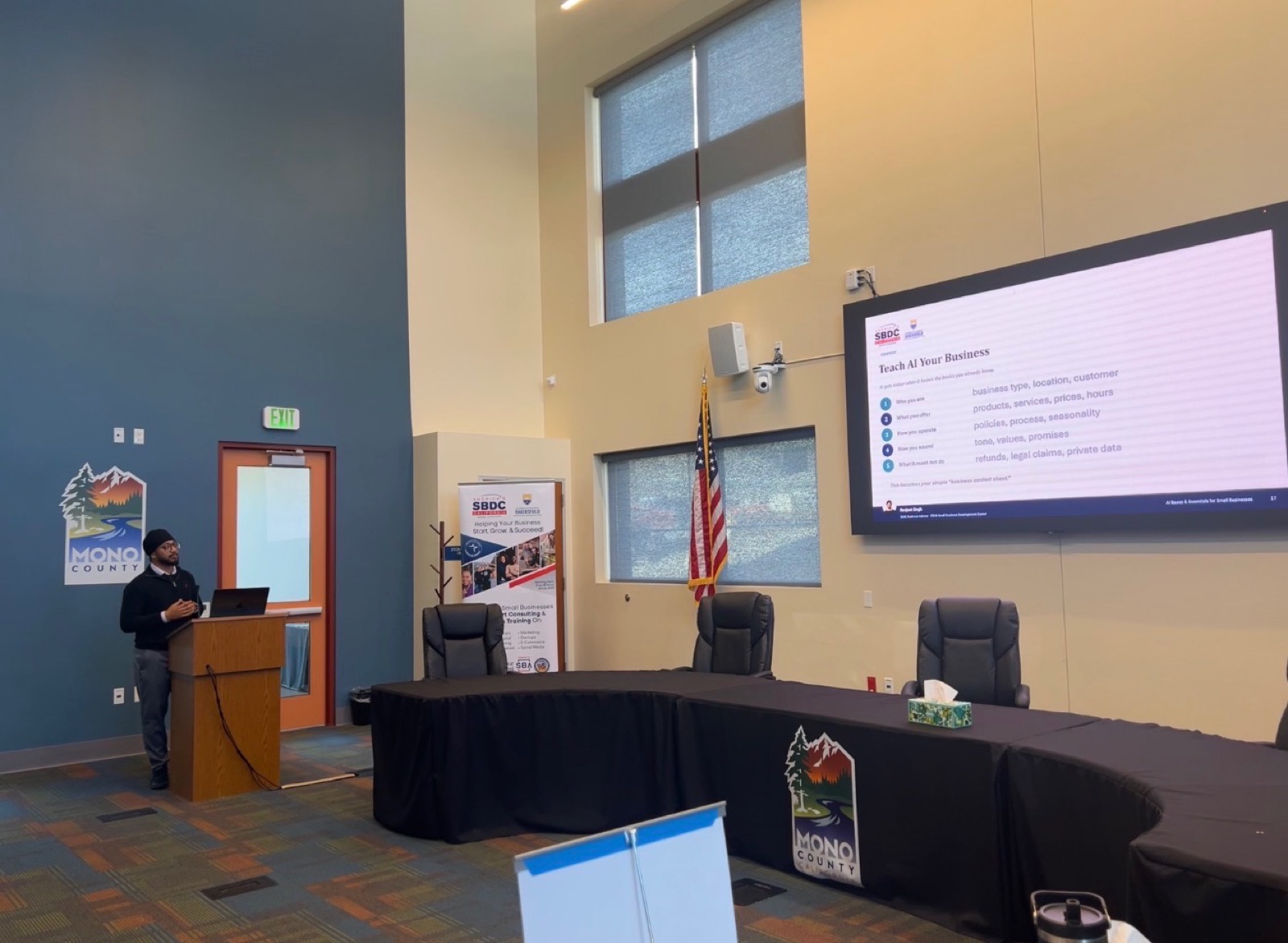
Delivery
- Local webinar, May 2026. An hour-long, live-Q&A session with co-presenter Victor Gonzalez, hosted by SBDC marketing consultant Maureen Buscher-Dang, covering AI for marketing projects, sales data analysis, and staff scheduling. It was previewed by The Bakersfield Californian on May 19, 2026.
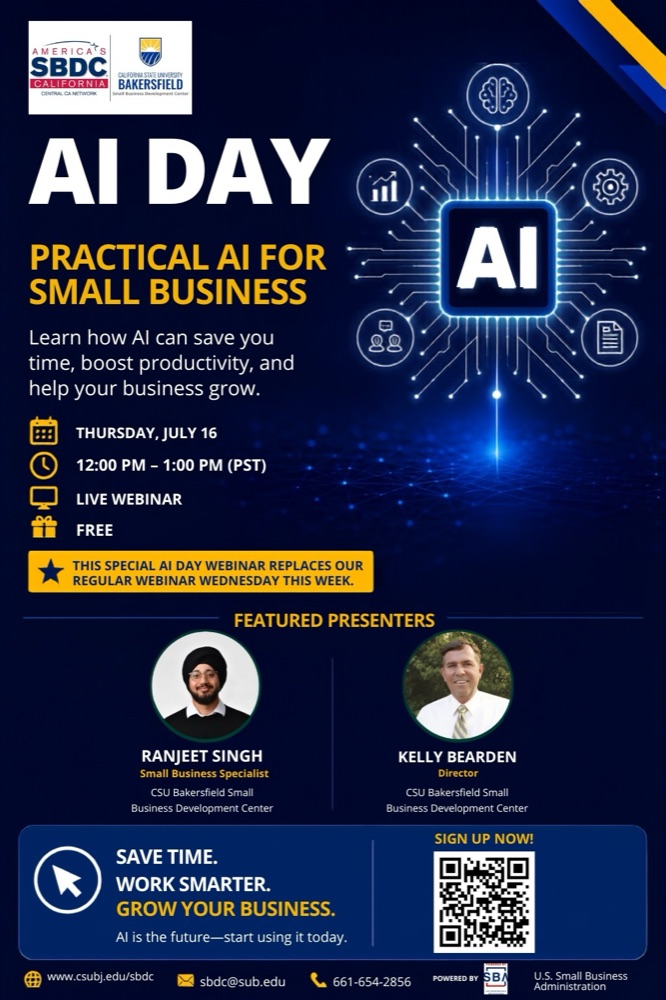
- AI Day: Practical AI for Small Business, July 16. A free live webinar presented alongside SBDC Director Kelly Bearden, scheduled in place of the SBDC's regular Webinar Wednesday.
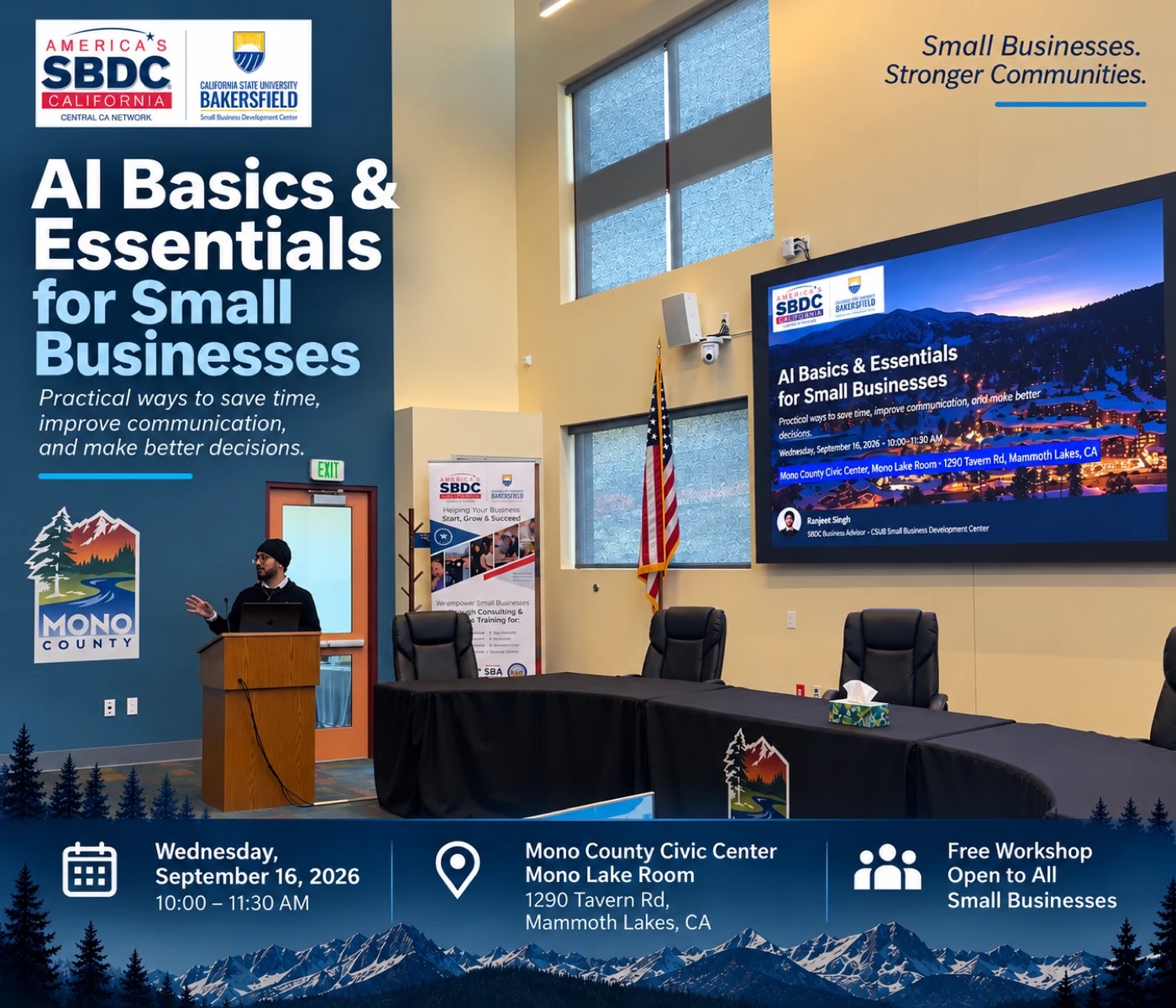
- In-person workshop, September 16, 2026. A free, 90-minute session in the Mono Lake Room at the Mono County Civic Center in Mammoth Lakes, open to all small businesses in the region.
What attendees took away
- A reusable business context sheet they could paste into any AI assistant to get consistent, on-brand output.
- A short list of high-value use cases to try first — marketing copy, customer replies, sales summaries, and scheduling.
- A clear "do not automate" list so owners can adopt AI without risking customer trust or privacy.
- A direct line to free, one-on-one SBDC advising for follow-up on funding, planning, and financial projections.
Reflection
The most useful thing I learned is that owners don't need more AI features — they need permission to start small. Framing the workshop around their own business, rather than around a product, made the technology feel practical rather than intimidating, and it made the guardrails part of the lesson rather than a warning label.